
Table of Contents
Introduction: Why Google Algorithms Matter
Florida (2003)
Big Daddy (2005–2006)
Caffeine (2010)
Pigeon (2014)
Fred (2017)
How SEO Strategy Evolved from Florida to Fred
Conclusion: Key Lessons for Modern Digital Marketers
Introduction: Why Google Algorithms Matter
Search engine optimization has never been static. Behind every search result you see on Google lies a complex system of rules and calculations known as “algorithms.” These algorithms determine which websites rank higher, which pages lose visibility, and how users experience search results.
For digital marketers and business owners, understanding major Google algorithm updates is essential because they directly influence traffic, visibility, and online success.
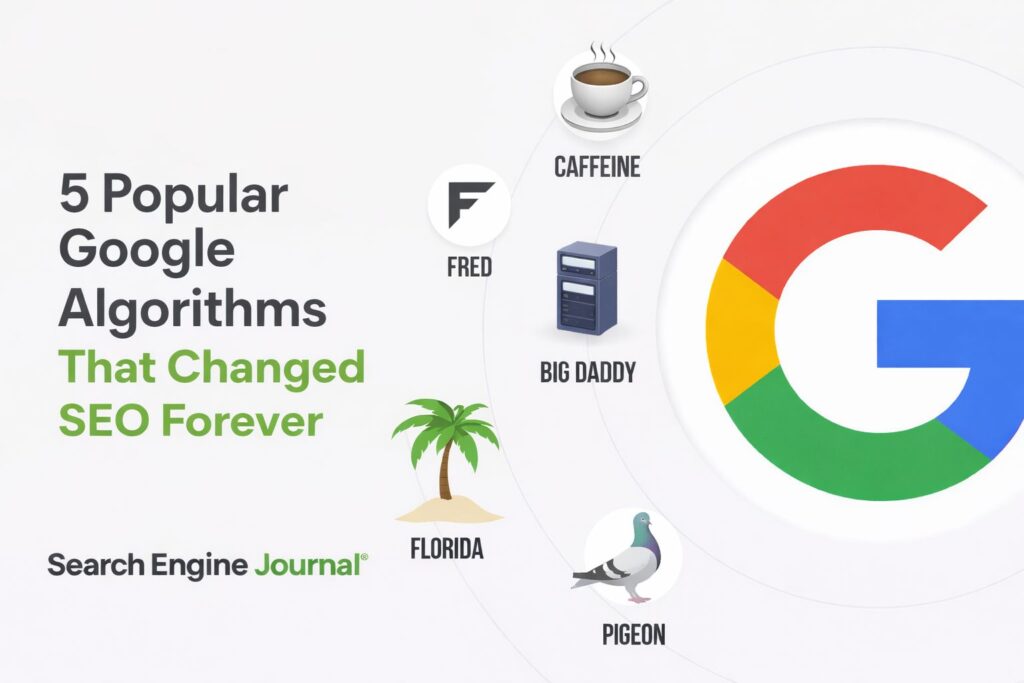
Over the years, Google has rolled out hundreds of updates. However, some algorithms reshaped SEO more dramatically than others. Among them, Florida, Big Daddy, Caffeine, Pigeon, and Fred stand out as milestones that forced marketers to rethink their strategies. Let’s explore how these five popular Google algorithms changed SEO forever.
Florida (2003)
Introduced in 2003, the Florida update was one of Google’s first major algorithm changes. At the time, SEO was largely driven by keyword stuffing and manipulative tactics. Many websites ranked simply by repeating keywords excessively and using hidden text.
Google launched Florida to clean up low-quality search results and reduce spammy practices. The algorithm targeted websites that relied heavily on exact-match keywords and artificial optimization techniques.
The major change Florida brought was stricter filtering of on-page spam tactics. Websites that had ranked at the top for competitive keywords suddenly disappeared from search results overnight.
This update had a massive impact on e-commerce websites and affiliate marketers. Many businesses experienced dramatic traffic drops just before the holiday season. SEO strategies had to shift from keyword stuffing to more balanced content creation and natural optimization.
For example, an online store selling “cheap flights” might have previously ranked by repeating that phrase dozens of times on a page. After Florida, such tactics led to ranking penalties. Businesses had to focus on relevance and quality instead of manipulation.
Florida marked the beginning of Google’s long-term mission: rewarding value over tricks.
Big Daddy (2005–2006)
The Big Daddy update rolled out between late 2005 and early 2006. Unlike Florida, which focused mainly on content spam, Big Daddy targeted technical SEO and link quality.
Google introduced Big Daddy to improve how it handled backlinks, redirects, and canonical issues. During this time, many websites used link farms and questionable linking practices to boost rankings artificially.
The major change brought by Big Daddy was a more advanced evaluation of link quality and website structure. Google improved how it processed URLs and identified duplicate content. Poor-quality inbound links began to carry less weight, and unnatural linking patterns became risky.
This had a strong impact on websites relying heavily on bulk backlinks. Many sites lost rankings because their link profiles were exposed as manipulative. SEO professionals started paying closer attention to link relevance and authority rather than just link quantity.
For instance, a website that gained thousands of links from unrelated directories might have ranked well before Big Daddy. After the update, those links provided little to no value, forcing marketers to pursue more genuine link-building strategies.
Big Daddy pushed SEO into a more technical and strategic phase, emphasizing clean site architecture and credible backlinks.
Caffeine (2010)
In 2010, Google launched Caffeine—not just as an update, but as a complete change to its indexing system. Before Caffeine, Google updated its index in layers, meaning new content could take weeks to appear in search results.
Caffeine was introduced to make search results fresher and faster. With the rise of blogs, news platforms, and social media, users expected real-time information.
The major change was faster indexing and more frequent updates. Google could now process and rank new content almost instantly. This significantly improved the freshness of search results.
For websites and marketers, Caffeine shifted the focus toward consistent content creation. Freshness became a ranking factor in many niches, particularly news, trends, and current events.
For example, before Caffeine, a blog post about a trending topic might take days to rank. After caffeine, timely and relevant content could appear in search results within hours. This encouraged businesses to invest in blogging, content marketing, and regular updates.
Caffeine didn’t penalize websites directly. Instead, it raised the competition by rewarding speed, relevance, and timely publishing.
Pigeon (2014)
In 2014, Google introduced the Pigeon update, which significantly impacted local SEO. As mobile search usage increased, people began searching for services “near me,” such as restaurants, clinics, and stores.
Pigeon was designed to improve the accuracy and relevance of local search results. It strengthened the connection between Google’s local algorithm and its core ranking signals.
The major change was better location-based ranking accuracy. Local directories, map listings, and Google Business profiles gained more importance. Traditional SEO factors such as domain authority and backlinks began influencing local rankings more strongly.
This update had a significant impact on small businesses. Companies with well-optimized local listings benefited, while others without proper local SEO lost visibility.
For example, a local bakery with an updated profile, positive reviews, and consistent contact details across directories started ranking higher than competitors who ignored local optimization.
Pigeon made local SEO a serious discipline. Businesses had to focus on citations, reviews, local keywords, and geographic relevance to remain competitive.
Fred (2017)
The Fred update rolled out in 2017 and targeted low-quality, ad-heavy websites. Unlike previous updates focused on keywords or links, Fred focused on user experience and content value.
Google launched Fred to reduce the rankings of websites created mainly for ad revenue rather than user benefit. Many affiliate sites with thin content and excessive advertisements were affected.
The major change was stricter evaluation of content quality and monetization practices. Websites filled with low-value articles designed solely to generate clicks saw ranking drops.
Fred significantly impacted content-driven websites. Marketers realized that producing large volumes of shallow articles was no longer effective. Instead, in-depth, helpful, and user-focused content became essential.
For instance, a blog publishing short 300-word articles packed with affiliate links might have performed well before Fred. After the update, such sites lost traffic if the content lacked real substance.
Fred reinforced Google’s long-standing priority: put users first.
How SEO Strategy Evolved from Florida to Fred
From Florida to Fred, SEO transformed dramatically. In the early 2000s, optimization often meant manipulating keywords and exploiting loopholes. Florida ended basic keyword spam. Big Daddy addressed technical issues and link quality. Caffeine emphasized freshness and speed. Pigeon strengthened local relevance. Fred reinforced content quality and user experience.
Over time, SEO shifted from trick-based tactics to strategic marketing. The focus moved toward high-quality content, authoritative backlinks, technical excellence, local optimization, and user satisfaction.
The evolution clearly shows a pattern: every major update reduced shortcuts and rewarded authenticity.
Conclusion: Key Lessons for Modern Digital Marketers
The history of Florida, Big Daddy, Caffeine, Pigeon, and Fred teaches one powerful lesson: sustainable SEO requires long-term strategy, not quick hacks.
Google’s algorithms continue to evolve, but the direction remains consistent. Websites that prioritize valuable content, technical health, credible backlinks, local relevance, and user experience are more likely to succeed.
For digital marketing students and beginners, understanding these updates provides context. SEO is not about gaming the system—it is about aligning with Google’s goal of delivering the best possible results to users.
Create real value and stay adaptable, and your SEO strategy will stand the test of time.